Light up Safety and Curb Appeal All Year Long
Good driveway and entryway lighting is about more than style. It helps you see icy patches, find keys at the door, and feel safer when someone walks up at night. Around Colorado Springs, where fall evenings get dark earlier and snow can hide hazards, a thoughtful lighting plan makes a big difference.
Here, we are focusing on planning and specs, not on how to wire anything. The goal is to help you think through fixture placement, brightness levels, dark-sky-friendly choices, and smart controls like motion sensors and timers. With a solid plan, you can talk clearly with a licensed electrician and end up with outdoor lighting installation in Colorado Springs that fits your home, your family, and your neighborhood.
Partnering with a pro for the actual installation helps you get code-compliant work that stands up to wind, cold, and snow, instead of struggling with trial and error on your own. Let us start with how to map out your lighting zones.
Mapping Your Driveway and Entryway Lighting Zones
Before you think about fixtures, take a slow walk around your property at dusk and again when it is fully dark. Notice where you feel unsure of your footing or where your eyes have to work harder to see. Pay attention to things like:
- Steps, short or tall
- Uneven concrete or brick
- Steep driveway slopes
- Tight turns from the street or alley
- Dark corners near doors or shrubs
Next, break your exterior into simple lighting zones. Common zones around a typical Colorado Springs home include:
- Driveway approach from the street
- Parking area and garage doors
- Primary front entry door and porch
- Secondary side or back entry
- Walkways from driveway or sidewalk to the front door
Different zones usually call for different fixture types:
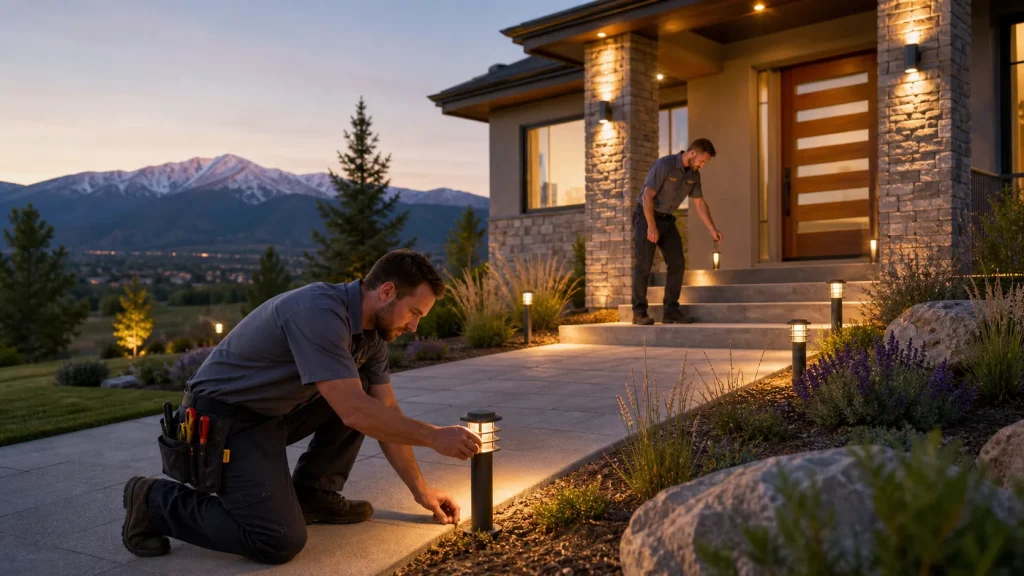
- Driveway edges: low bollard lights or shielded downlights to define the sides
- Garage doors: wall sconces or downlights on each side, or centered above
- Front porch: shielded porch lights, often one on each side of the door
- Steps: step lights in risers or small recessed fixtures along the sides
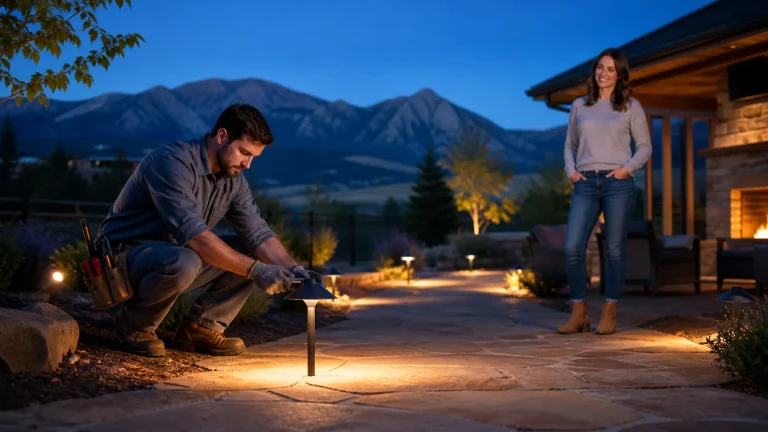
- Paths: short bollards or low-level downlights on posts or nearby walls
Mounting height matters. Garage and entry fixtures often work best around 6 to 7 feet above the ground, which keeps the light near eye level without shining straight into your eyes. Bollards usually sit 18 to 30 inches high, which lights the ground without spilling too far. As you plan spacing, think about overlapping light patterns, not isolated bright spots with dark holes between them.
Choosing Lumen Levels and Color for Comfort and Security
Old bulbs were sized by watts, but with LED fixtures, lumens are the better guide. Lumens tell you how much light you actually get. Two fixtures can use the same watts but give off very different brightness, so planning by lumens is more reliable.
Here are simple starting points many homeowners find helpful:
- Bollards and step lights: about 100 to 250 lumens each
- Garage or porch fixtures: around 400 to 800 lumens each
- Walkways: several lower-output fixtures spread out, instead of one bright fixture
Think in terms of total light over the area, not just one very bright light. For example, three smaller fixtures along a driveway often feel safer and more comfortable than one high-powered flood that blasts everything.
Color temperature also affects how your lighting feels. For entry doors and porches, warm to neutral light around 2700K to 3000K feels welcoming and flattering. Near driveways and parking pads, a slightly cooler white, around 3000K to 3500K, can make it easier to see edges and obstacles without feeling like a parking lot.
Be careful with over-bright fixtures, especially in snowy months. Too many lumens in a small area can cause glare, where your pupils tighten and you actually see less. Balanced, even illumination helps your night vision and keeps eye strain low, which is important when snow on the ground is already reflecting light back at you.
Dark-Sky Friendly Design and Glare Control
Colorado has strong dark-sky awareness, and many homeowners want to keep stars visible while still feeling secure. The good news is you can have both. It comes down to directing light where you need it and blocking it where you do not.
Look for full-cutoff or well-shielded fixtures. These are designed so the light shines downward onto the ground, doors, and paths, with very little light going up into the sky or into bedroom windows. Features to look for include:
- Opaque tops so light cannot shine straight up
- Shields or hoods that block direct view of the bulb
- Louvers or baffles that soften the beam
Beam spread is another planning tool. Narrower beams work well to mark driveway edges, spotlight an address number, or highlight a single step. Wider beams are better for washing a porch or area near the garage door with softer light. The goal is enough coverage that you can see clearly, without hot spots that spill over fences or across the street.
Snow makes glare control even more important. Flat lenses that sit horizontal can bounce light right into drivers’ eyes once they are covered with snow or ice. Instead, choose fixtures with angled faces, diffusers, or recessed light sources that hide the LED. When in doubt, think about where your eyes will be when you pull into the driveway and try to keep fixtures out of that sight line.
Smart Controls, Motion Sensors, and Timers for Security
Controls are where safety, comfort, and energy use all meet. A thoughtful control plan lets your lighting work for you automatically, so you are not always flipping switches.
Common outdoor lighting controls include:
- Photo sensors that turn lights on at dusk and off at dawn
- Programmable timers that follow a schedule you set
- Motion sensors that switch brighter lights on when they detect movement
A layered strategy works well for many homes. For example, you might have low-level path or bollard lighting on from dusk to dawn for basic safety. Then, brighter fixtures near garage doors and main entries can stay off most of the time but switch on when motion is detected.
Placement and aim of motion sensors are important. They usually work best:
- Along driveways, aimed to catch people or cars coming in, not the whole street
- Near garage doors, set to cover the area where you step out of a vehicle
- At main entries, focused on the walkway and porch area
Sensitivity and time delay should be tuned so every passing car or blowing branch does not trigger a light show. A licensed electrician can help adjust coverage patterns, wire controls into existing circuits, and make sure everything is ready for possible smart-home upgrades later.
Turning Your Lighting Plan Into a Professional Design Review
Once you have walked your property, thought about zones, and have a general sense of fixture types, lumen levels, and control ideas, it helps to put it all on paper. A simple sketch of your driveway, walkways, doors, and steps is enough. Mark where you think each light should go, roughly how bright it should be, and how you would like it to behave, such as dusk-to-dawn, motion-activated, or on a timer.
From there, meeting with a licensed, insured residential electrician lets you refine that plan. They can suggest fixture styles that match your goals, confirm that mounting heights and spacing will avoid dark gaps, and check that everything lines up with local electrical code, typical Colorado Springs weather, snow loads on fixtures, and any HOA rules that apply.
At Pink Brick Electric, we focus on helping homeowners turn ideas like these into outdoor lighting installation in Colorado Springs that is safe, dark-sky mindful, and easy to live with in every season. A clear plan, paired with professional installation, gives you driveway and entry lighting that looks good, feels safe, and works the way you expect whenever the sun goes down.
Get Started With Your Project Today
If you are ready to make your yard safer and more inviting after dark, we are here to help you plan and install the right lighting solution. Our licensed electricians handle every step of your outdoor lighting installation in Colorado Springs so you can enjoy reliable, beautiful results without the hassle. Reach out to Pink Brick Electric with your questions or ideas, and we will walk you through options that fit your home and budget. To schedule a visit or request a quote, simply contact us today.